
PlatformDeploy
Run your applications in your own AWS account
You pick the account, the region, and the size. Cenna builds the network, the database, the containers, and the identity wiring, then rolls the application out and checks that it answers. Your data never leaves your account.
01Without Cenna
What this looks like without Cenna
Every one of these is a thing a platform team would otherwise build, own, and be paged about. On Cenna they are already done.
Doing it yourself
- Write and maintain a Dockerfile
- Build and host container images
- Stand up ECS or Kubernetes
- Create the VPC, subnets, and security groups
- Provision Postgres and Redis
- Create object storage and queues
- Buy a domain and manage DNS records
- Request and rotate TLS certificates
- Put a load balancer in front of it
- Wire SSO to your identity provider
- Store and rotate secrets
- Build a CI/CD pipeline
- Wire logging, metrics, and alerts
- Write and rehearse a rollback path
- Keep all of it patched
15 things to own
All you decide
- Which AWS account and which region
- How big it needs to be
- The config values and secrets
- Who on your team can deploy
4 decisions
The list on the left does not go away because you ignore it. It goes away because someone already built it.
02Deployment
Walk through a deployment
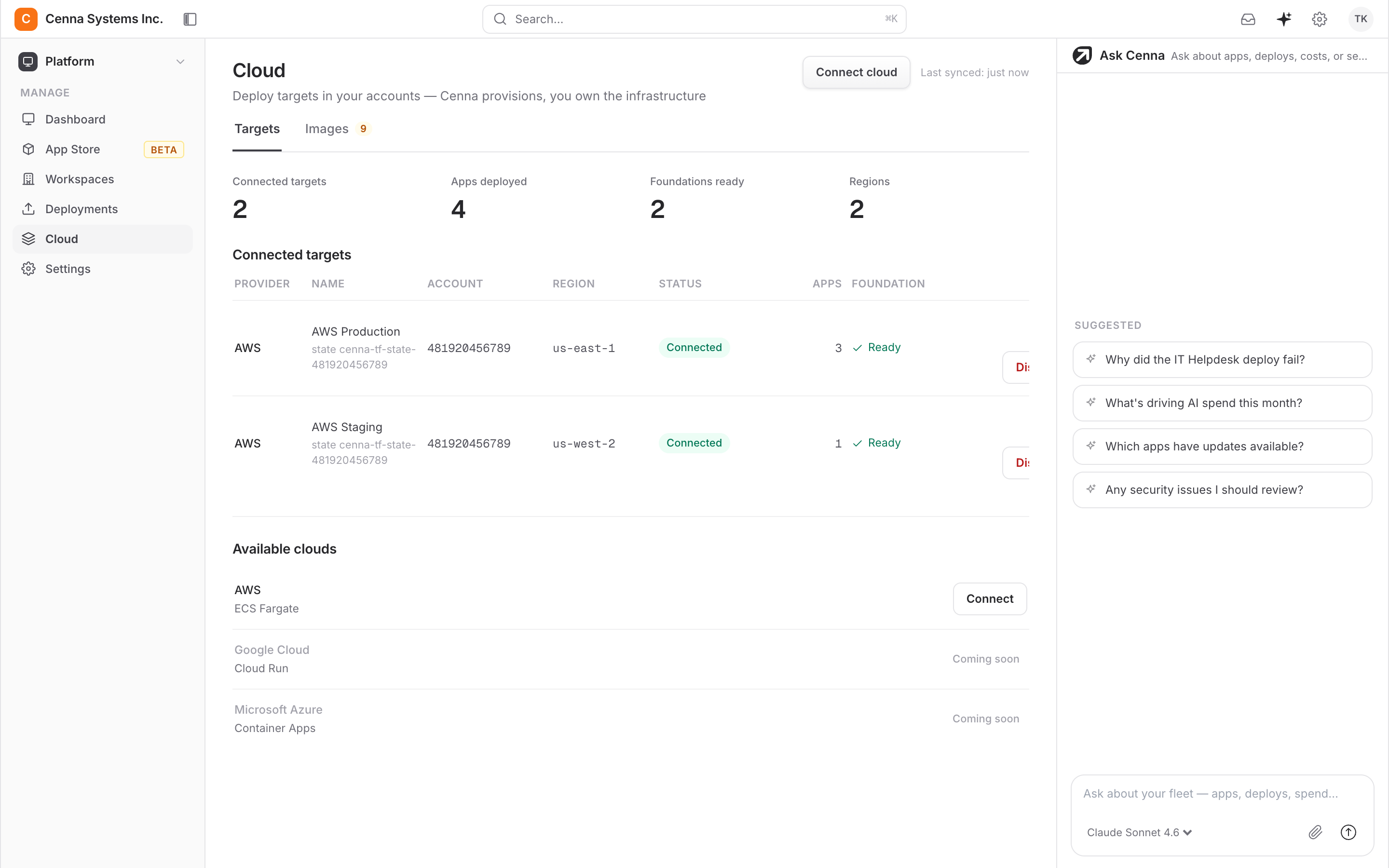
It runs on its own. The note beside it explains the step on screen.
Deploy RFP Response Studio
Install into a workspace. Apps and spend roll up under that team.
03Operations
An agent that runs operations with you
Cenna runs a DevOps agent alongside your applications. It reads your CloudWatch logs, ECS events, and RDS metrics, and it answers in plain language, so finding out why something broke, what is slow, or where the money is going does not start with opening four consoles.
Ask it anything about your fleet
- Why did the deployment fail?
- Which app is using the most tokens?
- Is anything degraded right now?
- What changed in the last release?
- Why is Contract Hub slow?
CloudWatch logs and metrics · ECS service events · RDS Performance Insights
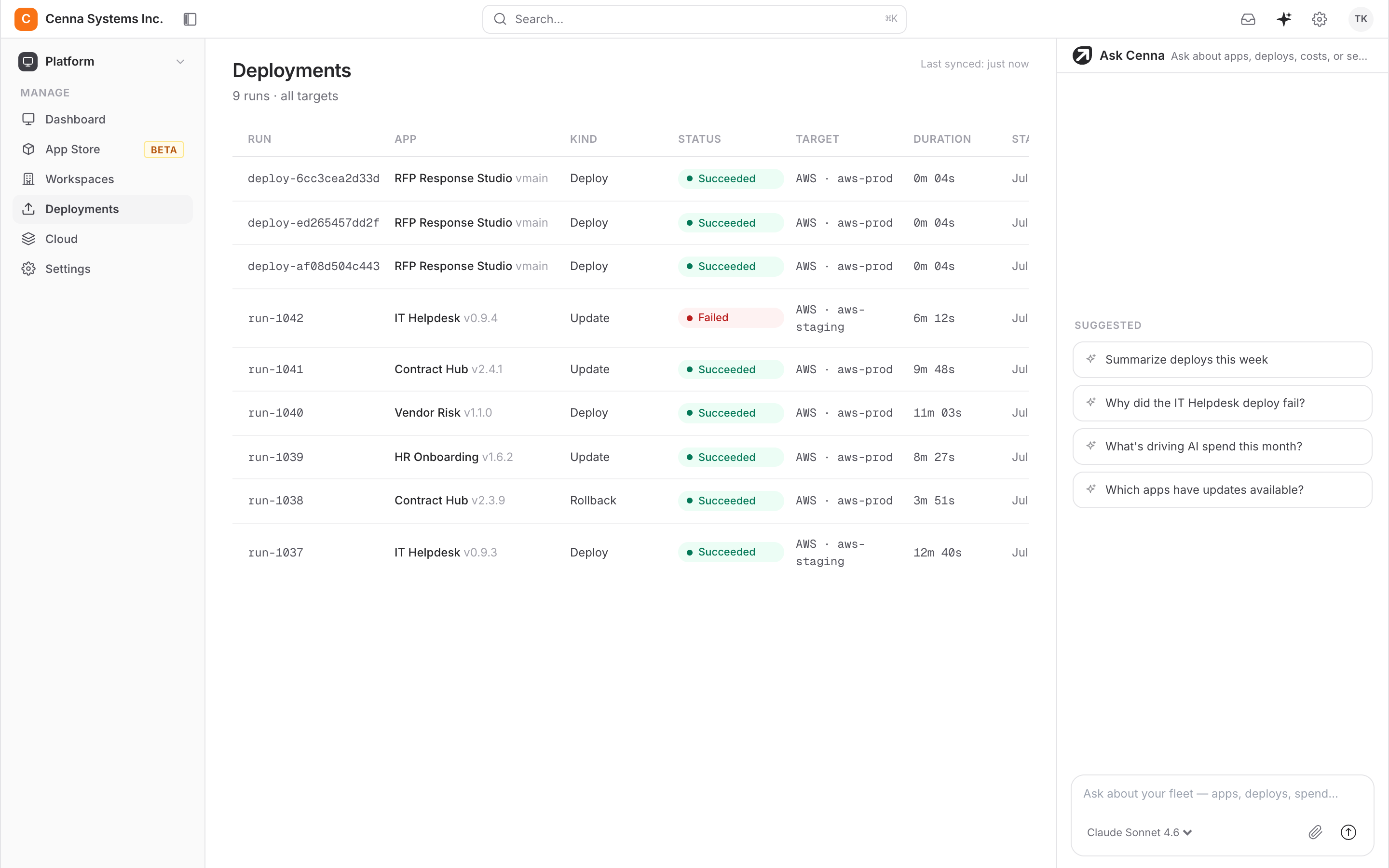
Why did the IT Helpdesk deploy fail?
- Read ECS service events
- Pulled CloudWatch logs · last 15 min
- Compared against the previous release
The new tasks never passed their health check.
/health returned 503 for four minutes. DATABASE_URL is pointing at the staging database, which this VPC cannot reach. Traffic never shifted, so v0.9.3 is still serving. Correct the value and redeploy.
04Day two
After it is running
The same path handles every change, so a release is not a project.
Ship an update
The same seven steps run again. Traffic moves to the new tasks only once they pass their health check.
Roll back
Every deployment keeps the image and the plan that produced it, so going back is one action rather than an incident.
Read the logs
Runtime logs stream in the console next to the deployment that produced them, so you are not hunting through CloudWatch.
See the bill
Cloud cost is reported per application, per service, beside the model spend for the same app.
05FAQ
Common questions
What access does Cenna need in our account?
A deployment role that you create and can revoke. Cenna assumes it to run the deployment and to read health and cost back. It has no standing access to your data, and removing the role stops all of it.
Can we deploy into an existing VPC?
Yes. You can let Cenna create the network or point it at subnets you already run, which is the usual answer when a landing zone and its guardrails are already in place.
Does this fit our existing pipeline?
The deployment runs from the console or from the CLI, so it drops into whatever already triggers your releases. Nothing requires your team to adopt a new CI system.
What happens if a deployment fails?
It stops at the step that failed and shows you the log for it. Nothing shifts traffic until the health check passes, so a failed deployment leaves the running version serving.
Who pays for the AWS resources?
You do, on your own bill, at your own negotiated rates. Because it is your account, existing commitments and discounts apply the same way they do to anything else you run.
See a deployment into a real account.
Thirty minutes: we walk the seven steps end to end and show you exactly what lands in the account and what the role is allowed to do.
Get a DemoBuilt for speed. Engineered for control.