
PlatformDeploy
Run your applications in your own Google Cloud project
Choose a project, a region, and a size. Cenna stands up the VPC, Cloud SQL, Secret Manager, and the Cloud Run service, then scales each application on demand. Up under load, down to nothing when it is idle. Everything stays inside your project.
01Without Cenna
The Google Cloud setup you skip
A production-grade Cloud Run application is not one command. It is a project of its own: the VPC connector, the Cloud SQL instance and its private IP, the service accounts, the Artifact Registry, the load balancer and certificates. Cenna has done all of it.
Doing it yourself
- Write and maintain a Dockerfile
- Push images to Artifact Registry
- Stand up Cloud Run and a VPC connector
- Create the VPC, subnets, and firewall rules
- Provision Cloud SQL with a private IP
- Set up Memorystore, buckets, and Pub/Sub
- Buy a domain and manage Cloud DNS
- Provision and renew managed certificates
- Put a load balancer in front of it
- Wire SSO to your identity provider
- Store and rotate secrets in Secret Manager
- Build a Cloud Build pipeline
- Wire Cloud Logging, Monitoring, and alerts
- Write and rehearse a rollback path
- Keep base images and dependencies patched
15 things to own
All you decide
- Which Google Cloud project and which region
- How big it needs to be
- The config values and secrets
- Who on your team can deploy
4 decisions
The list on the left does not go away because you ignore it. It goes away because someone already built it.
02Deployment
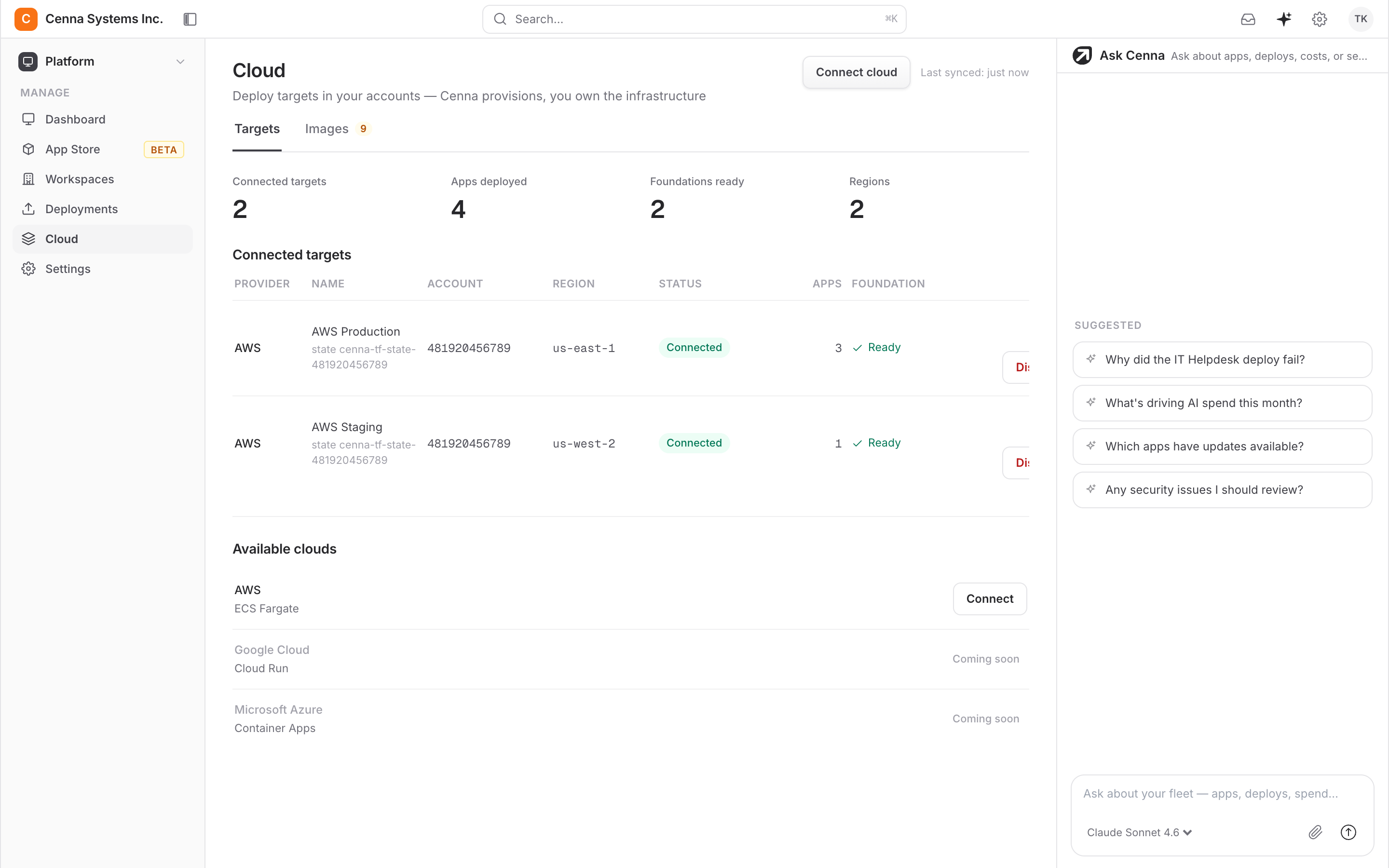
Watch a Google Cloud rollout
It plays on its own. The note beside each step says what is happening in your project.
Deploy RFP Response Studio
Install into a workspace. Apps and spend roll up under that team.
03Operations
An agent that runs operations with you
Cenna runs a DevOps agent beside your applications. It reads Cloud Logging, Cloud Run revisions, and Cloud SQL Insights and replies in plain language, so tracing a bad rollout or a spend spike does not mean opening four Google Cloud consoles.
Ask it anything about your fleet
- Why did the deployment fail?
- Which app is using the most tokens?
- Is anything degraded right now?
- What changed in the last release?
- Why is Contract Hub slow?
Cloud Logging and Monitoring · Cloud Run revisions · Cloud SQL Insights
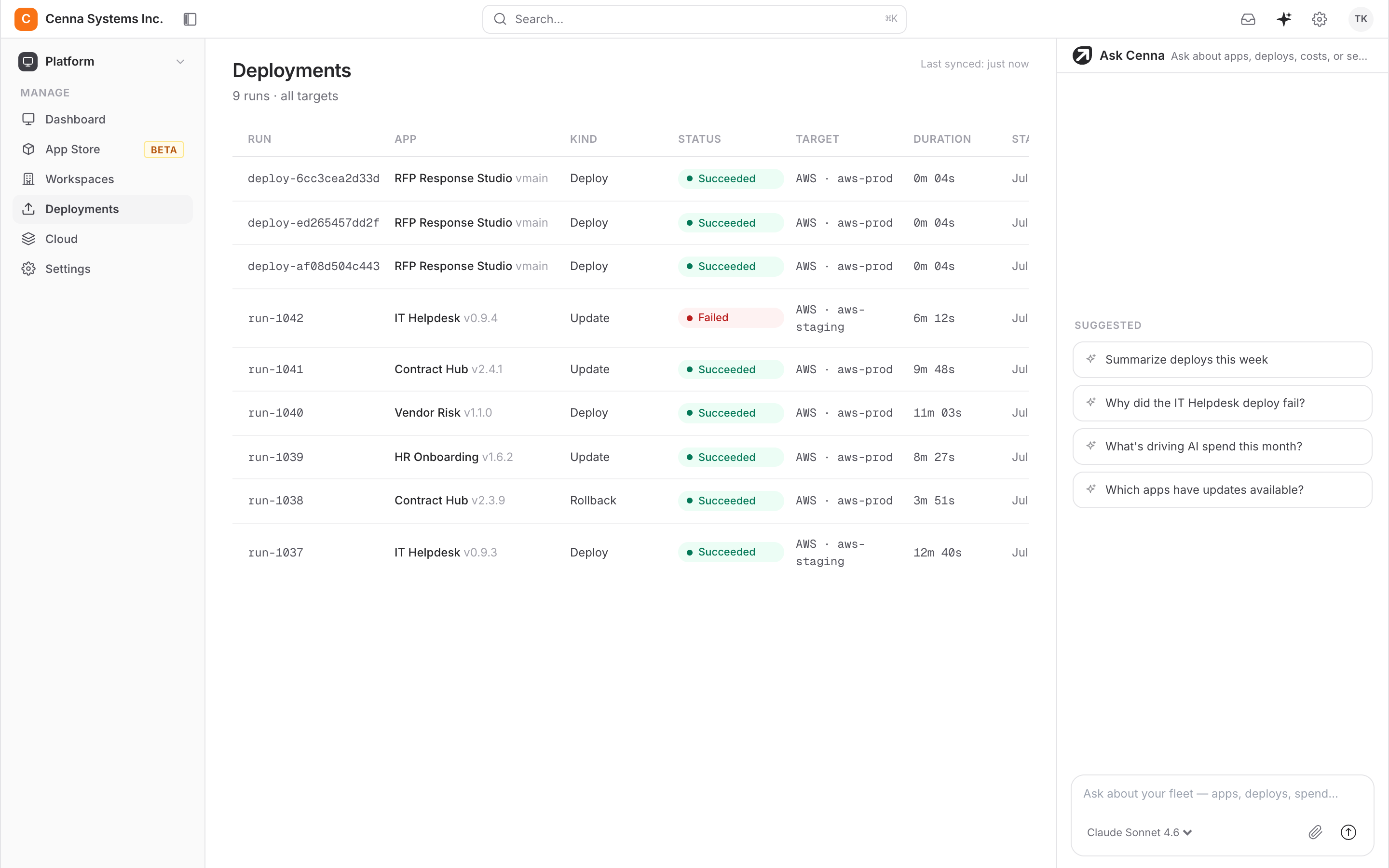
Why did the IT Helpdesk deploy fail?
- Read Cloud Run revision events
- Pulled Cloud Logging entries · last 15 min
- Compared against the previous release
The new revision never passed its health check.
/health returned 503 for four minutes. DATABASE_URL is pointing at the staging instance, which this VPC connector cannot reach. Traffic never shifted, so v0.9.3 is still serving. Correct the value and redeploy.
04Day two
Once it is live
Every change runs the same rollout, so shipping again is routine rather than a project.
Ship a new revision
A new revision starts beside the current one. Cloud Run shifts traffic only after it answers healthy, and you can split traffic to canary it first.
Roll back in one move
Previous revisions stay ready, so reverting is a traffic switch back, not a rebuild, not an incident.
Read the logs in place
Cloud Logging entries stream in the console beside the revision that produced them, so you are not pivoting between projects to trace one request.
Watch the spend
Cloud Run bills only while requests are being served, and Cenna reports that cost per application beside the model spend for the same app.
05FAQ
Common questions
What access does Cenna need in our project?
A service account you create and can unbind at any time. Cenna impersonates it to run the rollout and to read health and cost back. It has no standing path to your data, and removing the binding ends the connection.
Can we run inside a Shared VPC?
Yes. Cenna can create the network, or attach to a Shared VPC and the connector your platform team already governs. Which is the common answer where an org policy and its constraints are in force.
Do we have to change how we ship today?
No. The rollout triggers from the console or the CLI, so it slots into whatever already kicks off your releases. There is no requirement to move onto Cloud Build if you run something else.
What if a rollout does not come up healthy?
Cloud Run holds traffic on the current revision until the new one passes its health check. A bad revision simply never receives traffic, and the console shows the log for the step that stalled.
How does Cloud Run billing work here?
You pay Google directly, on request-based pricing, at your own rates. Because it runs in your project, committed use discounts and scale-to-zero apply exactly as they would for anything else you operate.
See a rollout into a real project.
Thirty minutes: we run the seven steps end to end and show you exactly what lands in the project and what the service account may touch.
Get a DemoBuilt for speed. Engineered for control.