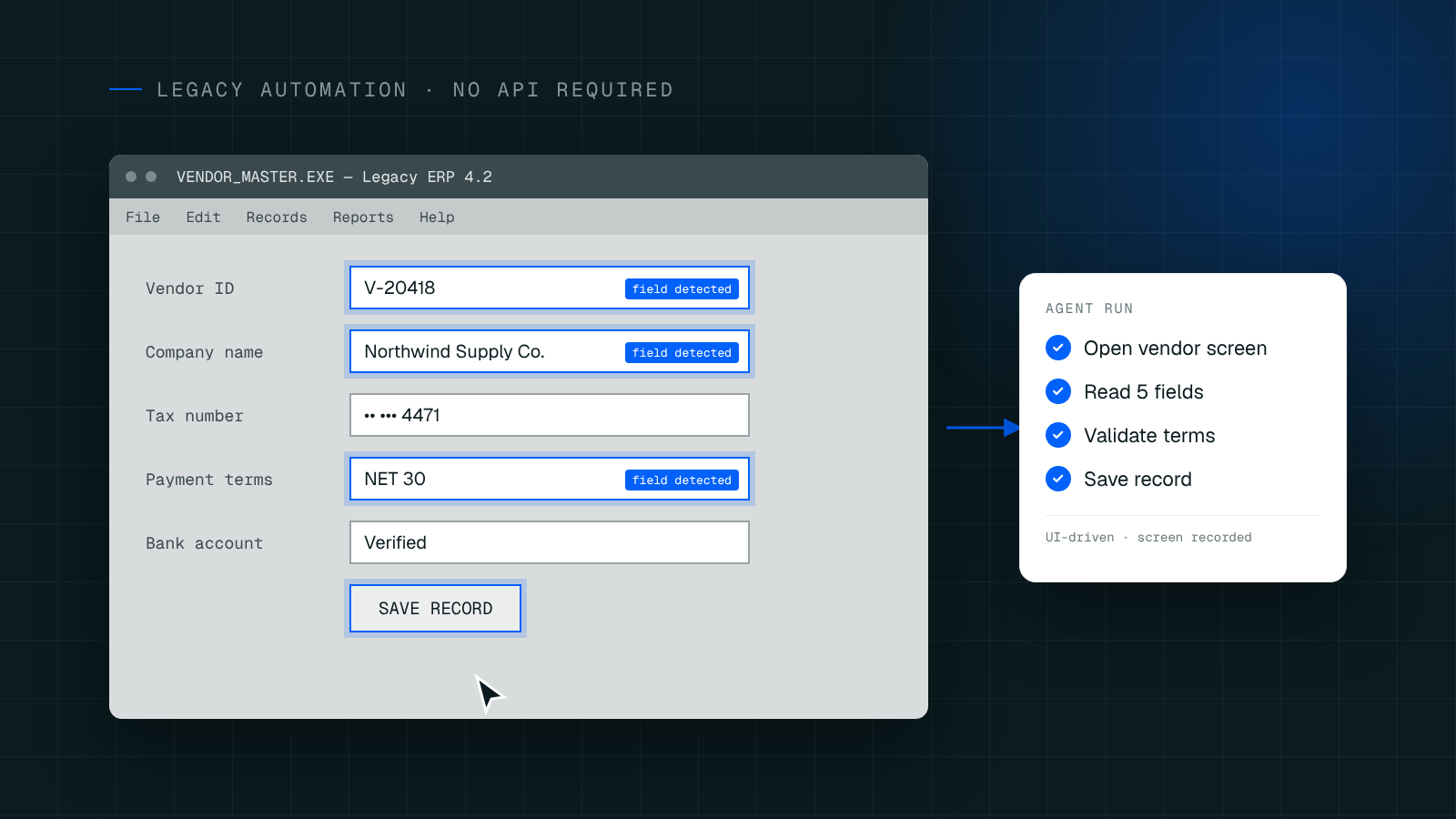
In an era defined by API integrations and cloud-native applications, a frustrating reality remains for most enterprises: a vast amount of critical work is still trapped in systems nothing can connect to.
Whether it is a 2004 homegrown claims system, an aging ERP, a government regulatory portal, or a supplier site, these applications lack APIs. Because they have no connectors and no modern endpoints, traditional automation tools fail. The result? Enterprises resort to using human employees as the "integration," paying people to manually copy and paste values from one window to another, all day long.
Until now, the systems were considered impossible to automate efficiently. Cenna is changing that by replacing manual data entry with intelligent, agentic automation that operates exactly how a human does: through the screen.
The End of the "Connector" Limitation
Traditional workflow builders and integration platforms all require a connector. If a vendor never shipped an API, the integration simply ends there.
Historically, companies attempted to solve this with Robotic Process Automation (RPA). However, RPA relies on brittle rules—recording clicks at exact pixel positions. If a button moves slightly or a label is renamed, the RPA bot breaks, requiring immediate IT intervention. RPA also requires managing a farm of dedicated virtual desktop infrastructure (VDI) machines, running up heavy licensing and maintenance costs.
Cenna sidesteps both the API limitation and the fragility of RPA. Cenna’s agents don’t look for an API, and they don't blindly click on X/Y coordinates. They read the interface like a human. If an agent is told to click "Submit," it visually finds the submit button, regardless of where the UI update moved it.
How Cenna’s Legacy Automation Works
Cenna agents operate in browser sessions directly within your cloud environment, securely following your established rules.
Show It the Task Once: You simply describe the job in plain language (e.g., "enter approved invoices from the queue into the supplier portal") and walk the agent through it once.
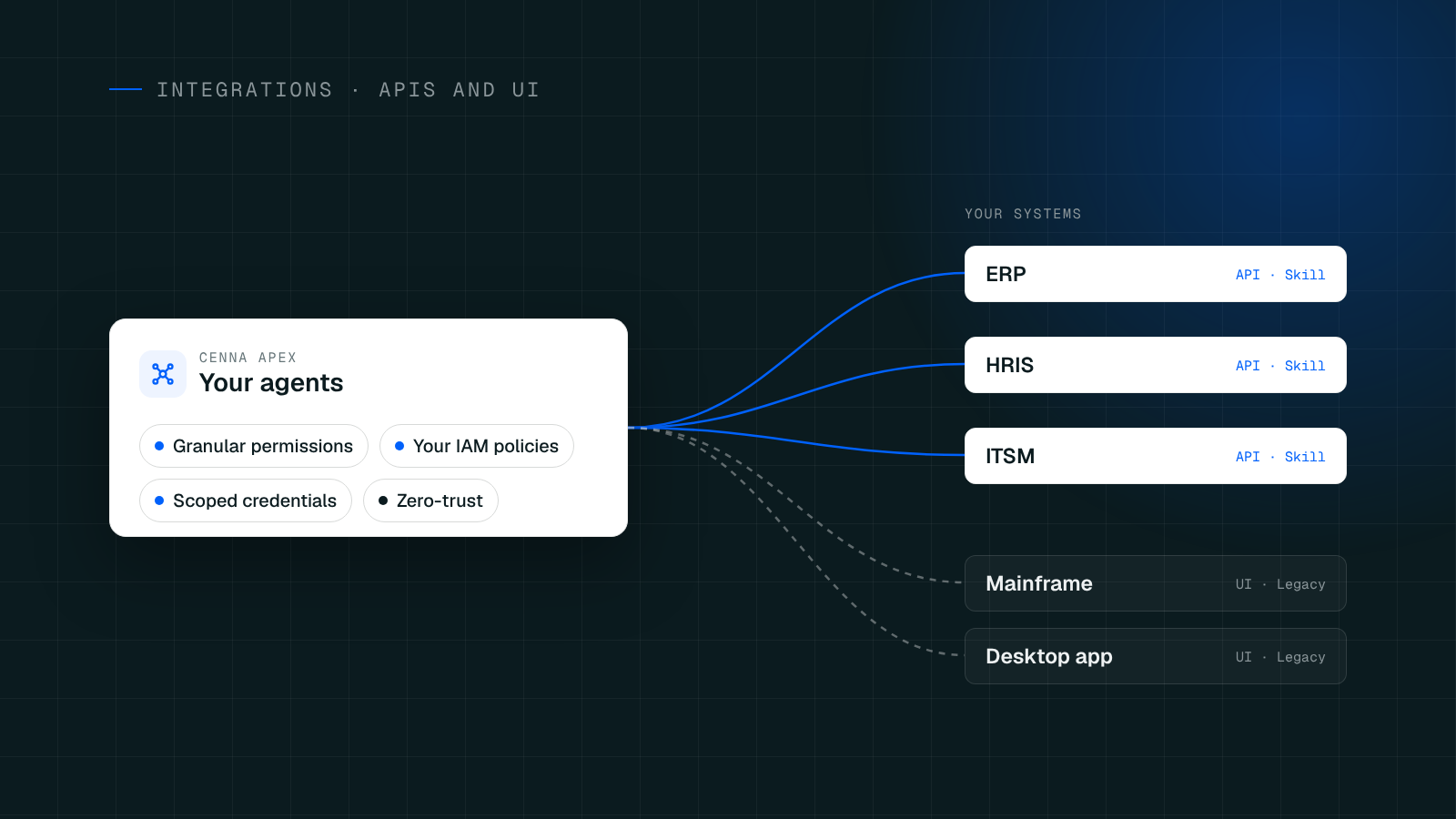
Secure, Independent Login: The agent isn't borrowing a human employee's login. It gets its own scoped credential, fully managed and revocable by you in a single click. It even handles SSO and MFA flows directly within its session.
Intelligent Screen Navigation: The agent reads the page, fills out fields, and clicks buttons. It verifies that each step landed properly before moving to the next. If a page changes so drastically that the task becomes ambiguous, the agent will stop and ask a human for help rather than guessing and causing an error.
Complete Auditability: Unlike a human making a typo at 4:45 PM on a Friday, the Cenna agent records every single step. Screenshots are captured for every action, meaning any run can be reviewed end-to-end, alongside the cloud cost of that specific run.
Scaling Without Machines
Perhaps the biggest operational shift Cenna introduces is how it scales. Traditional bots require a farm of VDI machines that sit idle most of the day but still cost money and require patching.
Cenna eliminates the machines. The agents run in browser sessions natively within your cloud account. They spin up instantly when work arrives, scale to run in parallel when there is a massive queue of tasks, and scale down to zero overnight when idle. You only pay for the work being done, not for idle infrastructure.
Where Enterprises Are Putting It to Work
By bridging the gap between legacy UI and modern AI, enterprises are deploying Cenna to solve previously "un-automatable" bottlenecks, including:
Order and invoice entry in aging ERPs.
Claims lookups in Third-Party Administrator (TPA) or payer portals.
Data entry in supplier/vendor portals lacking APIs.
Government and regulatory filings.
Mainframe screens hidden behind web emulators.
Any internal, homegrown tool the vendor stopped updating.
Automation, with Absolute Control
Giving an AI agent access to legacy enterprise systems requires trust, which is why Cenna prioritizes governance.
Because Cenna operates in your own cloud account, you maintain total control. Furthermore, you can implement human-in-the-loop approvals before any critical action is taken. Want an agent to prep a government filing but wait for human sign-off before clicking "submit"? Cenna allows you to place a human approval gate in front of any step you choose.
The era of using highly paid professionals as human API connectors is ending. Cenna proves that even the most stubborn, outdated systems can be automated—intelligently, securely, and at scale.
Frequently asked questions
What happens if the agent encounters an unexpected or drastically changed screen?
The agent will stop and ask a human for help rather than guessing and risking an error.
How does Cenna handle login credentials and security like MFA?
The agent uses its own scoped, revocable credential rather than borrowing a human's login, and it handles SSO and MFA flows directly within its session.
Can humans still review or approve actions before they happen?
Yes, Cenna allows you to place a human approval gate in front of any step, such as requiring sign-off before a government filing is submitted.